When key employees leave an organization, they take more than just their personal belongings—they walk out with years of undocumented, invaluable institutional knowledge. For mid-market enterprises across Southeast Asia, this invisible “brain drain” is one of the most critical threats to sustainable operational growth.
Without a structured system to capture and retain this intellectual property, organizations suffer from severe operational friction, duplicated efforts, and slow, gut-feel decision-making. Adopting a Business Intelligence Navigator is the ultimate way to capture, protect, and democratize your organization’s critical knowledge before it walks out the door.
In this comprehensive guide, we will explore the real cost of knowledge loss and demonstrate how STAX—built on Google Cloud Platform and backed by MatrixC’s Premier Partner expertise—serves as the perfect Business Intelligence Navigator to transform your scattered data into a unified, actionable intelligence hub.
Table of Contents
1. The Quiet Crisis of Institutional Knowledge Loss
Many corporate leaders fail to realize that their most valuable asset is the “tribal knowledge” locked inside their employees’ heads. When a senior operations manager or a lead engineer retires, decades of practical context, system workarounds, and vendor relationships are lost instantly.
Read more: Harvard Business Review on the Cost of Employee Turnover and Knowledge Loss
The statistics surrounding this challenge are staggering for modern businesses:
| The Knowledge Problem | Statistical Impact | Real-World Business Consequence |
|---|---|---|
| Wasted Time Searching | Employees spend an average of 9 hours per week | Severe drag on daily productivity; delayed responses to customer inquiries. |
| Knowledge Loss | 37% of institutional knowledge is undocumented | Immediate operational disruption when critical staff resign or retire. |
| Duplicate Work | Teams constantly recreate existing work | Inefficiency and waste; repeating past mistakes due to lack of historical record. |
For a standard 500-person enterprise, these inefficiencies translate to an average annual loss of over $6 million. Furthermore, companies with poor knowledge retrieval experience 42% longer employee onboarding times and a 23% decrease in overall staff satisfaction due to daily workplace frustrations.
2. Why a Business Intelligence Navigator is Essential to Stop Knowledge Loss
Relying on traditional databases, static wikis, or messy shared drives to preserve company knowledge simply does not work in the modern B2B landscape. Static documents quickly become outdated, and employees hate spending hours digging through poorly indexed folders.
┌────────────────────────────────────────────────────────────────────────┐
│                        Traditional vs. AI Knowledge                    │
├───────────────────────────────────┬────────────────────────────────────┤
│       Static Legacy System        │   Business Intelligence Navigator  │
├───────────────────────────────────┼────────────────────────────────────┤
│ • Scattered data silos            │ • Single, unified knowledge hub    │
│ • Keyword-only search queries     │ • Semantic, natural language Q&A   │
│ • High human dependency           │ • Decoupled from individual minds  │
│ • Manual report generation        │ • Real-time automated insights     │
└───────────────────────────────────┴────────────────────────────────────┘
This is where a Business Intelligence Navigator becomes an indispensable asset. Instead of forcing employees to become data scientists or search experts, a navigator allows anyone to interact with corporate data using plain, conversational language.
By deploying a Business Intelligence Navigator, employees can immediately retrieve accurate context, historical precedents, and technical specifications in seconds. Introducing a Business Intelligence Navigator is not just about organizing files; it is about establishing an active, self-learning ecosystem. A dedicated Business Intelligence Navigator tracks changes, connects disparate platforms, and ensures that critical operational expertise is preserved permanently.
Additional Reading: How a National Healthcare Authority Broke Data Silos with Google Cloud & AI
3. Unveiling the STAX Intelligence Platform Architecture
STAX combines the advanced infrastructure of Google Cloud Platform, cutting-edge machine learning models, and MatrixC’s implementation expertise to create a secure, high-performance insight engine.
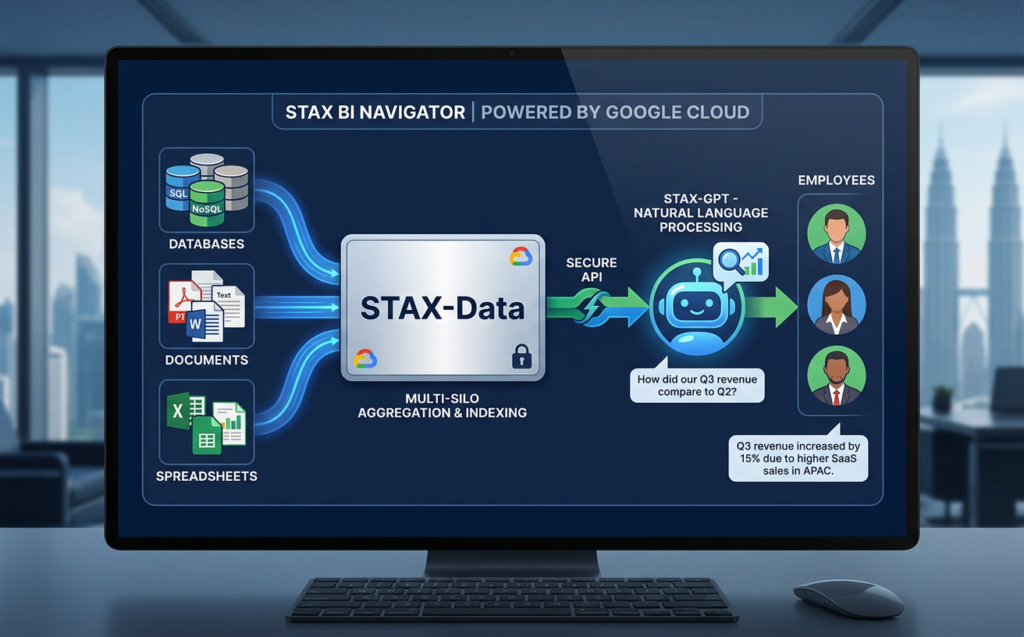
The platform achieves this through two highly integrated components:
STAX-Data: Your Single Source of Truth
STAX-Data connects to your scattered business information, transforming spreadsheets, APIs, databases, and unstructured PDFs into a unified intelligence hub. It automates data ingestion pipelines, processes complex analytics, and handles data preparation behind the scenes so your team always works with fresh, trustworthy numbers.
STAX-GPT: Your Conversational AI Advisor
STAX-GPT is the intuitive conversational interface that brings your data to life. It leverages semantic search technology to understand the intent behind user questions, delivering precise answers rather than just keyword matches.
Operationalizing STAX-GPT as Your Day-to-Day Business Intelligence Navigator
Through natural language, this Business Intelligence Navigator delivers answers, summarizes long policy documents, and extracts key trends without requiring a single line of SQL code. Most importantly, it respects strict Role-Based Access Control (RBAC), ensuring that sensitive financial or HR data is only visible to authorized personnel.
4. Departmental Impact: How STAX Empowers Every Business User
Unlike traditional business intelligence tools that require extensive training, STAX is designed to be utilized by every employee across your organization, serving as an intuitive Business Intelligence Navigator for all.
Learn more: Data Analytics: Stop Staring at Dashboards, Start Making Decisions
Here is how different departments leverage this advanced tool to eliminate knowledge loss and accelerate growth:
| Department | Common Pain Point | STAX Solution | Core Business Metric |
|---|---|---|---|
| Human Resources | Slow onboarding; lost operational knowledge when senior staff retire. | Instant policy access; automated training modules; central historical archives. | 42% Faster Onboarding |
| Sales & Marketing | Slow response times; outdated pricing sheets; scattered customer context. | Unified customer profiles; 24/7 product specification access; competitive intelligence. | 28% Higher Close Rates |
| Operations & Finance | Days spent manually compiling spreadsheets; missed performance patterns. | Automated pipeline reporting; real-time margin exceptions; instant anomaly alerts. | 75% Reporting Automation |
| IT & Development | Flooded help desks; undocumented legacy code; system downtime. | Secure self-service knowledge base; automated issue troubleshooting; IT asset monitoring. | 45% Fewer Support Tickets |
Whether it is a sales rep on the road needing immediate pricing context or a CFO analyzing quarterly performance, STAX ensures the right answers are always one simple question away, transforming STAX into an active Business Intelligence Navigator that connects departments seamlessly.
5. Real-World Success: Mid-Market Case Studies in Southeast Asia
To understand the true impact of deploying a secure Business Intelligence Navigator, let’s look at three practical success stories from mid-market businesses:
1. Stopping the Margin Bleed in Distribution
A $35 million Southeast Asian distribution company was struggling with profitability issues, only discovering margin leaks weeks after the quarter had closed. When they implemented a custom Business Intelligence Navigator built on STAX, the platform was configured to scan their transactions daily. The STAX-Data engine acts as the foundation of your Business Intelligence Navigator, automatically flagging problematic orders in real-time. Within 90 days, leadership stabilized their pricing and achieved an 18% improvement in overall margins.
2. Preserving Decades of Experience in Professional Services
A leading professional services firm faced a major crisis when several senior partners announced their retirement, threatening to leave incoming staff without decades of crucial historical context. Deploying a modern Business Intelligence Navigator preserves this tribal knowledge by ingesting thousands of case files, emails, and client documentations into a secure GCP environment.
Check out: Google Cloud Platform Enterprise Security and Compliance Framework
As a result, new hires used natural language prompts to understand complex precedents instantly. This powerful tool enabled them to reach 85% productivity in just 4 weeks, compared to the previous average of over 16 weeks, which has proven to be an invaluable asset to the firm’s operations.
3. Creating a Unified B2B Customer Experience
A mid-sized B2B company had customer information scattered across sales logs, support tickets, and accounting applications, leading to inconsistent client communication. By integrating STAX-Data, the company established a single view of the customer. STAX-GPT quickly analyzed interaction histories to highlight churn-risk accounts, leading to a 24% increase in account retention and a 31% expansion in existing client accounts.
6. The 4-Step Blueprint to Implementing Your Insight Engine
Transitioning from data chaos to automated clarity is simple and structured. MatrixC’s proven onboarding process ensures your business achieves immediate value without complex, months-long development cycles:
| Step | Phase Name | Typical Timeframe | Primary Activities |
|---|---|---|---|
| 1 | Discovery & Planning | 1–2 Weeks | Knowledge source inventory, user needs assessment, security mapping, roadmap creation. |
| 2 | Capture & Connection | 2–4 Weeks | Secure document ingestion, live database API integration, encryption setup, model training. |
| 3 | Configuration & Training | 2–3 Weeks | User interface customization, department use case setup, custom entity extraction, training. |
| 4 | Go-Live & Optimization | Ongoing | Phased department rollout, usage monitoring, active AI model tuning, quarterly reviews. |
Your enterprise’s custom Business Intelligence Navigator grows smarter with every single interaction, developing into a powerful competitive advantage that remains entirely your unique intellectual property.
7. The MatrixC Advantage: Your Enterprise-Grade AI Partner
Implementing advanced artificial intelligence in a corporate environment requires more than just importing a public API. It requires deep cloud architectural expertise, robust security standards, and local market understanding.
As a Google Cloud Premier Partner with over 17 years of experience running cloud operations for hundreds of enterprises across Southeast Asia, MatrixC ensures your STAX deployment is safe, scalable, and highly efficient.

We ensure your private business data is protected using state-of-the-art encryption at rest and in transit. By combining GCP’s world-class, regional storage compliance with MatrixC’s dedicated post-launch support and performance monitoring, we deliver enterprise-grade performance without the typical enterprise complexity or price tag.
Find out more: The Critical Security and Cost Benefits of GCP Auditglance
8. Conclusion: Future-Proof Your Corporate Mind Today
Don’t let your company’s valuable expertise slip away. Protecting your business from tribal knowledge loss and data silos is no longer a challenging IT project—it is a strategic necessity that can be resolved in weeks.
Integrating your Business Intelligence Navigator into tools like Google Workspace or Microsoft Office allows your team to stop wasting hours searching and start focusing on strategic execution. Turn STAX into the default Business Intelligence Navigator for your corporate environment to secure your knowledge and empower your workforce today.
💡 Transform Your Corporate Knowledge Instantly
Are you ready to see STAX in action and eliminate data silos across your organization?